For operators in the metalworking industry who work daily with grinding, milling, or welding processes, metal dust is part of their everyday work. What is often underestimated is that metal dust is not merely a nuisance, but a serious health risk with far-reaching consequences for employees, the company, and the operator. Those who are aware of the dangers and take the right protective measures not only protect their workforce but also themselves from personal liability.
This article answers the most important questions about metal dust in the workplace: from health risks and applicable limit values to effective technical protective measures.
Why is metal dust so dangerous in the workplace?
Metal dust is so dangerous in the workplace because fine particles penetrate deep into the respiratory tract, cannot be broken down by the body, and can cause serious illnesses over the years. Particles smaller than 10 micrometers (PM10) and smaller than 2,5 micrometers (PM2,5) are considered particularly respirable and therefore especially critical.
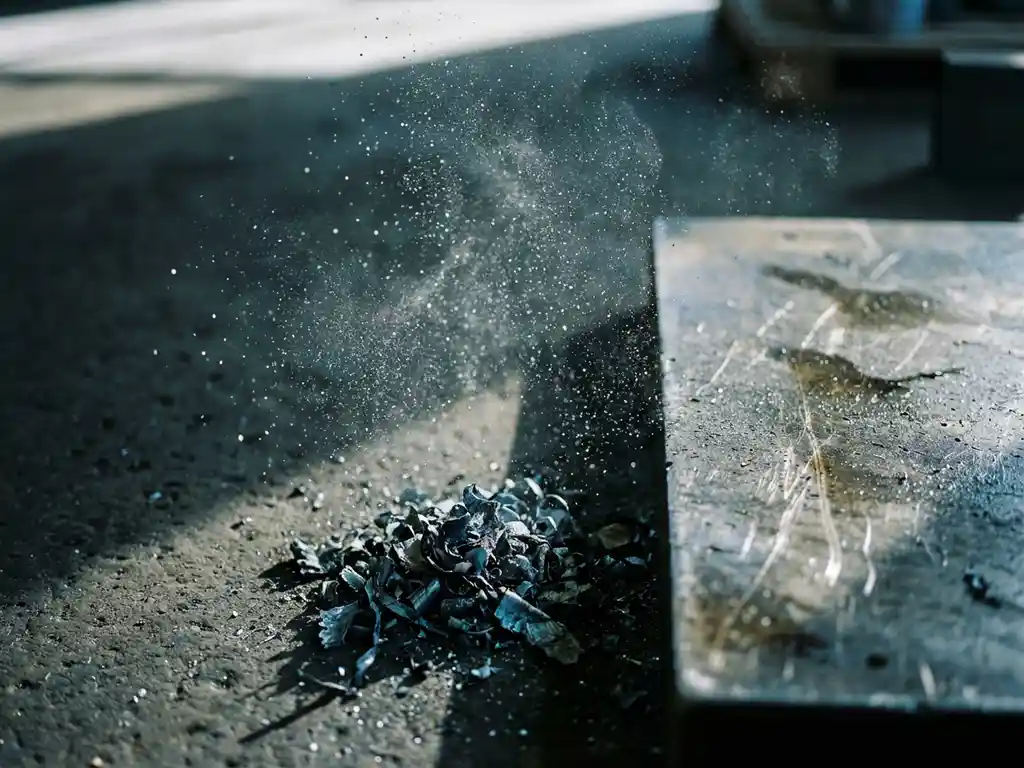
In addition, there is the chemical composition: Many metals, such as chromium, nickel, manganese, or lead, are toxic or carcinogenic. Grinding, welding, milling, or cutting not only produces coarse shavings but also ultrafine dust particles and fumes that float invisibly in the air. These particles are not visible to the naked eye but can be inhaled.
Another risk: Metal dust is explosive in certain concentrations. Aluminum, magnesium, and titanium dust are among the dusts with a high explosion potential. This means that metal dust in the workplace poses not only a health problem but also a safety hazard.
What diseases can metal dust cause?
Metal dust can cause a number of serious illnesses, including pulmonary fibrosis, silicosis, occupational respiratory diseases, and cancer. The type of illness depends on the specific metal, the duration of exposure, and the particle size.
Overview of typical illnesses caused by metal dust:
- Pulmonary fibrosis: Scarring of lung tissue due to long-term dust accumulation, common in welders and grinders.
- Siderose: Iron dust deposits in the lungs, mostly in welders.
- Manganism: Neurological disease caused by manganese exposure, with symptoms similar to Parkinson's disease.
- Lung cancer: Increased risk upon exposure to nickel and chromium compounds (Cr(VI))
- Contact dermatitis and allergies: Skin reactions caused by nickel, cobalt or chromium
- Chronic bronchitis: Persistent irritation of the respiratory tract due to fine dust pollution
Many of these diseases develop gradually over years or decades. By the time symptoms appear, the damage to the lungs or nervous system is often already irreversible. This makes regular occupational health check-ups and effective technical protective measures so important.
Which metal dusts are particularly harmful to health?
Particularly harmful are dusts containing chromium(VI) compounds, nickel, manganese, lead, cadmium, and beryllium. These substances are classified as carcinogenic, mutagenic, or toxic to reproduction and are subject to strict limits according to TRGS 900 and TRGS 559.
Carcinogenic metal dusts
Chromium(VI) compounds are formed during the welding and grinding of stainless steel and are considered known carcinogens (category 1A/1B according to the CLP Regulation). Nickel compounds are also suspected carcinogens and are present in many alloys. Cadmium, which can be released during soldering, additionally damages the kidneys.
Neurologically active metal dusts
Manganese is a particularly insidious hazardous substance: it damages the central nervous system without initially causing any symptoms. Lead is also neurotoxic and can accumulate in the body. Both substances are found in welding fumes, grinding dust, and foundry processes.
Flammable and explosive metal dusts
Aluminum, magnesium, and titanium form explosive mixtures at certain particle sizes and concentrations. These dusts are also subject to ATEX directives, which impose special requirements on extraction systems and electrical equipment.
What are the limit values for metal dust in the workplace?
Occupational exposure limits (OELs) for metal dust in the workplace apply according to TRGS 900. The general dust limit is 1,25 mg/m³ for respirable dust (A-dust) and 10 mg/m³ for inhalable dust (E-dust). Significantly lower, substance-specific limit values apply to specific metal dusts.
Some important substance-specific limit values according to TRGS 900:
- Chromium(VI) compounds: 0,01 mg/m³ (A-dust) as a technical guideline concentration value (TRGS 559)
- Nickel compounds: 0,006 mg/m³ (inhalable, as Ni)
- Manganese and its compounds: 0,02 mg/m³ (A-dust, as Mn)
- Lead and its compounds: 0,1 mg/m³ (inhalable, as Pb)
- Cadmium and its compounds: 0,004 mg/m³ (A-dust, as Cd)
According to DGUV regulations, operators are obligated to comply with these limit values and verify them through regular measurements. If limit values are exceeded, technical protective measures are mandatory. According to the STOP principle, personal protective equipment is only a last resort, not a replacement for technical solutions.
How can metal dust be effectively extracted in the workplace?
Metal dust is most effectively removed by extraction close to the source, directly at the point of origin. This captures the dust before it disperses into the room air. Three factors are crucial: the correct capture efficiency, sufficient air volume, and a suitable filter medium for the specific type of metal dust.
The process follows a clear scheme: collection at the source, transport via the pipeline system, filtration in the separator, and subsequent recirculation or discharge of the cleaned air. For toxic or carcinogenic dusts such as chromium(VI) or nickel, an outside air intake or a filter class H (HEPA) is mandatory.
Important design parameters for the extraction system:
- Air volume: Must be calculated based on the number of simultaneously active extraction points.
- Filter class: For carcinogenic dusts, at least class H according to DIN EN ISO 11057.
- Coverage level: Source-level extraction is always preferable to room extraction.
- ATEX suitability: Absolutely essential for flammable metal dusts (e.g., aluminum).
Who visites industrial extraction applications Anyone planning a plant should clarify early on which substances will be produced and in what quantities. The process description is the basis for any correct plant design.
When is personal respiratory protection no longer sufficient for metal dust?
Personal respiratory protection is no longer sufficient for metal dust if limit values are consistently exceeded, carcinogenic substances are released, or several employees are exposed simultaneously. According to the STOP principle (Substitution, Technical Measures, Organizational Measures, Personal Protective Equipment), PPE is always the last resort.
Specific situations in which PPE alone is not sufficient:
- Exposure to chromium(VI), nickel or other carcinogenic metal dusts during continuous operation
- Several employees are working simultaneously in a poorly ventilated room.
- The exposure duration exceeds the permissible wearing time of the respiratory mask.
- Employees are not wearing masks consistently or incorrectly
- Limit values are regularly exceeded despite the use of PPE.
Respiratory masks offer no protection against skin contact with metal dust and do not protect the eyes. Furthermore, they are often unsuitable for employees with beards, certain face shapes, or respiratory conditions. In contrast, mechanical extraction systems create clean air for everyone in the work area, regardless of individual behavior.
A typical challenge: Companies rely on respiratory protection for too long because the initial purchase costs of an extraction system seem higher. However, they fail to consider the subsequent costs resulting from occupational illnesses, accident insurance inspections, fines, and production losses. suitable filter systems and extraction systems Using this reduces overall costs in the long term and protects against personal liability.
How ULMATEC helps with metal dust extraction
At ULMATEC, we develop, manufacture, and install industrial extraction systems specifically designed for the challenges of metalworking. For operators who need to capture metal dust safely and in compliance with standards, we offer concrete technical solutions:
- Extraction systems designed for air volumes from 3.000 to 250.000 m³/h, scalable in sizes S to XXL
- Filter systems with over 100 filter combinations, including HEPA class H for carcinogenic metal dusts such as chromium(VI) and nickel.
- ATEX-compliant versions for combustible metal dusts such as aluminum or magnesium
- Modular system with over 10 million system variants for individual process requirements
- Complete technical documentation for DGUV inspections and official visits
- Eligible systems according to BAFA and KfW funding for cost-efficient investments
Our Services We offer engineering, manufacturing, and assembly from a single source. Experienced specialists accompany the project from the initial process analysis to the fully operational system. If you are unsure which system is right for your process, please contact us directly. Get in touch now and request a free initial consultation.